为量化 LimX-WBT 的跟踪质量,我们在内部评测集上将其与当前业界最强的全身跟踪器 SONIC [1] 进行对比。评测采用我们在 Oli 上复现的 SONIC 版本,其训练数据和算力与 LimX-WBT 相同。评测集由一组参考运动构成,覆盖 locomotion、manipulation 等日常人体动作;两个控制器分别跟踪同一组动作,并依据参考运动评分。LimX-WBT 在跟踪精度和平滑度两项指标上均取得更优结果:
表 2。LimX-WBT 与 SONIC 在内部全身跟踪评测集上的对比(数值越低越好)。
指标
SONIC
LimX-WBT
跟踪精度
Mean Per-Joint Position Error (MPJPE)
13.75 mm
12.85 mm
Mean Per-Joint Angle Error (MPJAE)
3.3°
1.5°
平滑度 —— 运动 jerk
关节空间 jerk
129.2
115.2
底盘朝向 jerk
113.0
90.3
平均关节角误差(MPJAE)的改善最为明显:LimX-WBT 将该指标相较 SONIC 降低了约 55%,同时将平均关节位置误差(MPJPE)降低了约 7%,复现的全身姿态更接近参考运动。跟踪精度提升的同时,平滑度也得到改善;这两项指标通常需要权衡。平滑度以运动 jerk 衡量,即运动的三阶时间导数,数值越低,动作的突变和抖动越少。在同一评测集上,LimX-WBT 的关节运动和底盘运动均比 SONIC 更平滑,关节空间 jerk 约低 11%,底盘朝向 jerk 约低 20%。在该基准上,LimX-WBT 相较当前业界最强方法同时取得了更高的跟踪精度和更好的运动平滑度。
年初,我们发布了机器人 OS 的首个版本 COSA 0。COSA 0.5 更新了其中的 S1(VLA)和 S0(运控)两层,本报告介绍了这两项更新。V³-0 是一套运行在真实人形机器人上的完整 VLA 技术栈:慢系统理解场景和指令,快系统生成全身运动,S0 负责全身跟踪与平衡。系统还支持真机全身专家接管,并包含 reward model 和 RL 更新回路。在当前评测的三个任务中,更新后策略的成功率均高于 BC 基线。
[1] Luo, Zhengyi, et al. "SONIC: Supersizing motion tracking for natural humanoid whole-body control." arXiv preprint arXiv:2511.07820 (2025).
[2] Black, Kevin, Allen Z. Ren, Michael Equi, and Sergey Levine. "Training-Time Action Conditioning for Efficient Real-Time Chunking." arXiv preprint arXiv:2512.05964 (2025).
引用本文
如需引用本文,可以使用以下 BibTeX 条目:
@online{fu2026cosa05,
author = {Zhen Fu and Tao Yu and Hongbo Zhu and Haoxiang Luo and Zhiming Chen and Pinxi Shen and Jiaqi Song and Zheyi Zhao and Bozhen He and Jiangtao Hu and Cong Shen and Haolin Ma and Zimo Huang and Ben Liu and Wei Zhang and Hua Chen},
title = {Introducing {COSA} 0.5: A Whole-Body Capability Upgrade for the Humanoid {VLA} {V³-0}},
date = {2026-07-15},
year = {2026},
url = {https://limxdynamics.com/cosa05v3/#en},
}
Summary
V³ ('V-cubed') is the VLA tooling layer in COSA, our robot OS. This report describes V³-0, released with COSA 0.5, and presents two main developments:
A humanoid VLA technology stack for mobile whole-body manipulation. V³-0 runs on Oli, a 43-DoF LimX humanoid. Its multi-tier architecture lets perception, decision-making, and execution operate at their respective rates; LimX-WBT tracks whole-body targets while maintaining dynamic balance. The stack unifies locomotion and manipulation as coordinated whole-body behavior, allowing Oli to walk, bend, and continuously perform one- or two-handed tasks in the real world.
Real-robot reinforcement learning with human-in-the-loop intervention. During autonomous execution, an expert can smoothly assume whole-body control at any time to correct critical deviations before they become unrecoverable failures or trap the policy in ineffective repetition. A real-robot reinforcement-learning loop built on physical interaction allows the policy to keep improving, repeat fewer mistakes, and recover more reliably from failure states to complete the task.
The name V³ ('V-cubed') combines the three V's in veni, vidi, vici ('I came, I saw, I conquered') as V cubed.
The complete tidying run, shown from start to finish in one unbroken take without cuts or resets: laundry placed in the hamper, the shark plushie set on the chair, boxes stacked, toys cleared from the desk, a chair straightened, trash put in the bin, and a wallet handed to the owner. Oli remains balanced throughout, repeatedly bending down to the floor.
1. What it does
Given the instruction to tidy the room, Oli walks in from the corner and begins working. It puts laundry in the hamper, clears toys from the boxes, stacks the boxes on the floor, removes toys from the desk, straightens a chair, clears trash from the table, and takes a wallet from the shelf and hands it to the owner. The full sequence runs in one continuous take. Oli remains balanced throughout, including repeated bends to the floor, and converts its visual observations into coordinated whole-body behavior.
The grasp itself is the easy part; the harder part is the surrounding sequence, and that difficulty arises from the robot's humanoid body. "Tidy the room" is not a single action: each task consists of walking to the relevant location, orienting the body, bending, reaching, grasping, and then moving to the next location. The robot must therefore produce more than two hand poses. Its legs, torso, head, arms, and hands must move as one coordinated system. Locomotion and manipulation are coupled throughout the task and must be solved together at every step.
These motions must also be performed on a body that can fall. A humanoid is kinematically unstable: reaching shifts its center of mass, each step transfers the load between the feet, and forward arm motion must be compensated elsewhere in the body. When Oli bends to take the shark plushie from the boxes and place it on the chair, almost the entire body moves to keep the center of mass over the feet. Tracking a hand target while holding the rest of the body fixed is not sufficient. The onboard system must meet the manipulation target in real time while keeping the 43-DoF humanoid balanced and within its dynamic limits at every step.
This report presents V³-0, a complete VLA stack deployed on Oli, a physical LimX humanoid with 43 degrees of freedom. The stack combines a model for scene and instruction understanding, a fast policy that generates whole-body motion, and a low-level controller for whole-body tracking and balance. We also operate a human-in-the-loop, real-robot RL loop: an expert can smoothly assume whole-body control at any time, while human-annotated failure segments from autonomous rollouts train a reward model that provides feedback for RL policy updates.
The following sections describe the fast–slow VLA, balanced execution by LimX-WBT, and the expert-takeover and policy-update loop on the real robot.
2. The whole system
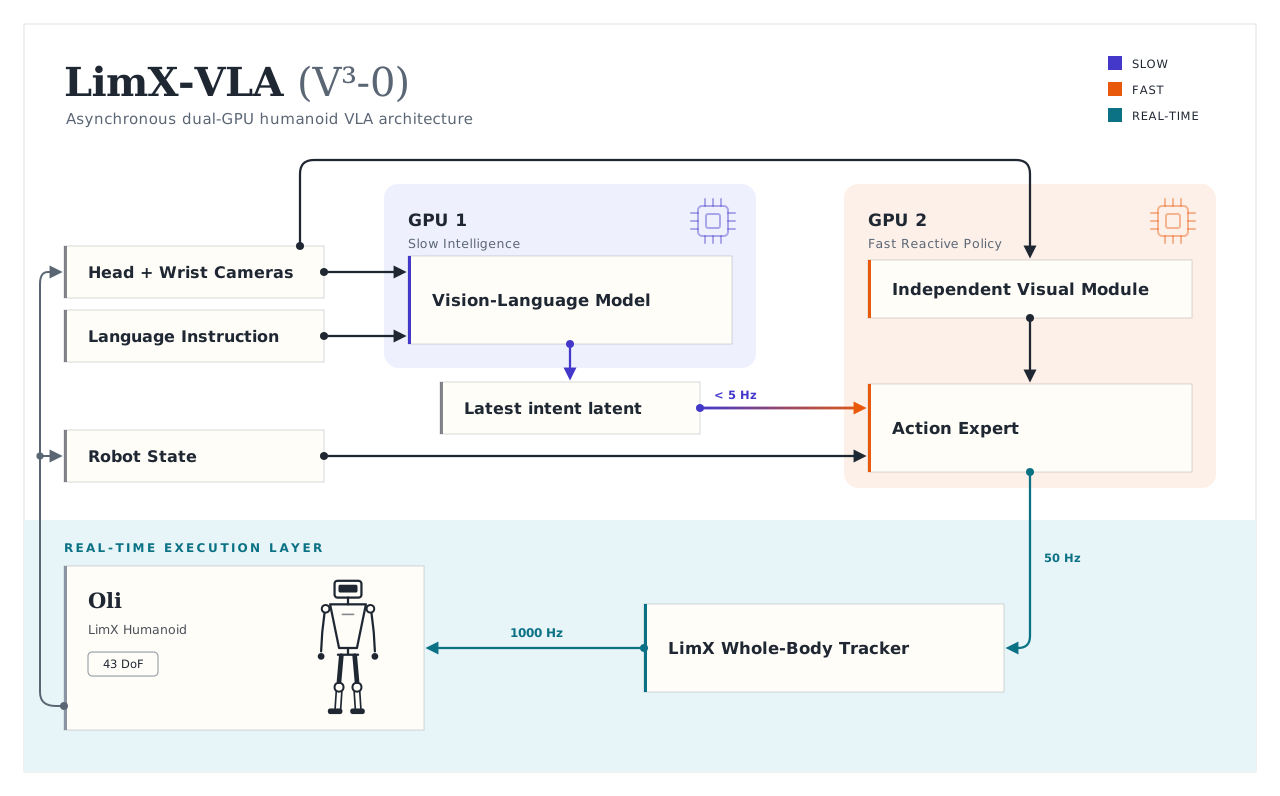
Figure 1. Asynchronous dual-GPU VLA architecture. The slow system produces an intent latent. The fast system combines the latest latent with visual features and robot state to generate whole-body motion targets, which LimX-WBT executes on Oli in real time. Each component runs independently at its own rate.
The architecture has three tiers, each operating at its own rate (Figure 1):
V³ slow system — understand. A vision-language model processes the head and wrist camera streams together with the language instruction, producing a compact representation of intent. This tier handles slower, deliberative computation.
V³ fast system — act. A compact, high-rate policy combines that intent with current camera observations and robot state. It generates short motion segments specifying targets for the hands, legs, base, and head over the next fraction of a second.
LimX-WBT — execute with balance. A single whole-body tracking policy converts those targets into joint commands for the legs, waist, arms, and head. It moves the robot while maintaining balance, meets the real-time control deadlines, and handles locomotion and manipulation through one controller.
The tiers communicate through intentionally narrow interfaces and do not run in lockstep. Each lower tier uses the latest output from the tier above, so every tier can operate at the rate appropriate to its function without pausing the control loop.
Each tier addresses a separate part of the system. The fast system emits a whole-body action chunk that represents locomotion and manipulation in one action space (§3). LimX-WBT tracks these targets while maintaining balance (§4). Real-robot reinforcement learning then uses real interaction data to continue updating the policy (§5).
3. Understanding and acting — the fast–slow VLA (S1)
The VLA converts language and vision into motion through two networks that receive the same observations but operate at different rates. The slow network handles scene and task understanding, while the fast network generates actions. These computations have different time scales: the semantic interpretation of a kitchen does not need to change a hundred times per second, whereas a reach toward a cup requires frequent updates.
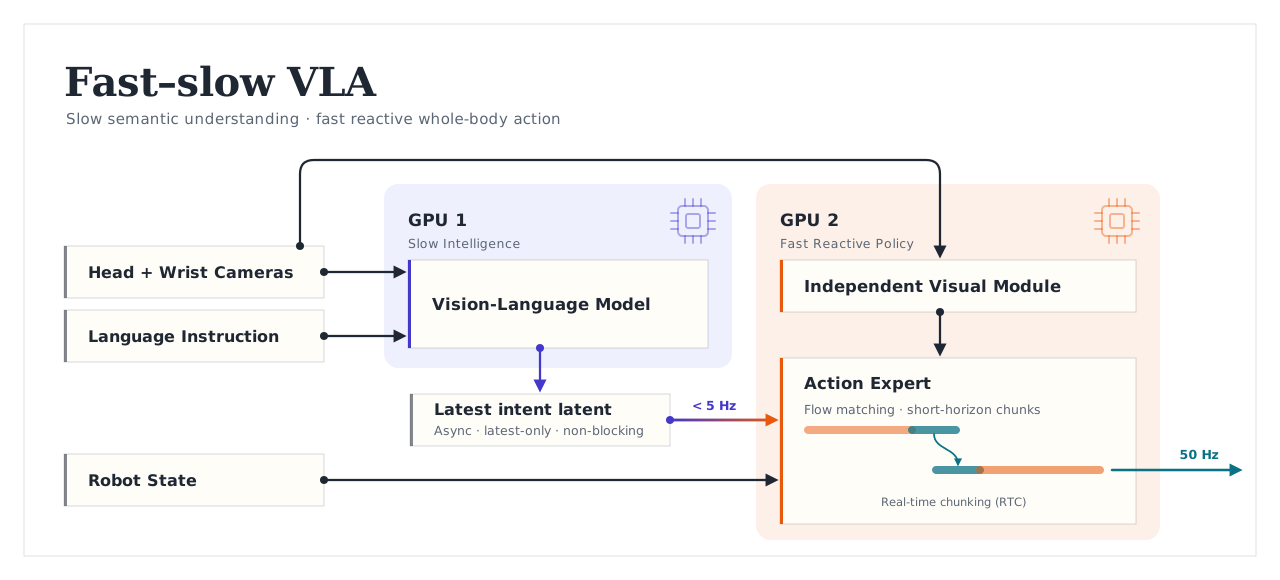
Figure 2. Fast–slow VLA. The slow system processes the cameras and instruction to produce an intent latent. The fast system combines the latest latent with camera observations and robot state to generate an action chunk, without waiting for another slow-system update. LimX-WBT then executes the action chunk (§4).
The slow system — understanding
The slow system is a vision-language model that processes the head and wrist cameras and the language instruction. It produces a compact latent representation of the scene and task, including the visible objects, their locations, the requested objective, and the next required step. This computation is relatively expensive and changes slowly compared with control, so it runs at the low end of the frequency hierarchy.
The fast system — acting
The fast system converts the slow system's latent, head and wrist camera inputs, and current robot state into whole-body motion. Direct access to the cameras lets it respond to the current scene rather than relying only on the latent. The system uses a small policy trained with flow matching. In a few denoising steps, it transforms noise into a smooth, continuous trajectory of future targets, allowing it to run at the rate required by the moving robot.
Rather than emitting individual actions, the fast system produces an action chunk: a short-horizon sequence of targets for the hands, legs, base, and head that lower tiers consume and refresh. For a humanoid, controlling the base is necessary because reaching an object elsewhere in the room first requires walking to it. Head control provides active perception: the robot turns its head toward the relevant object or placement location rather than restricting the head-camera view to the torso's facing direction. Its gaze therefore follows the current task.
During deployment, the fast system generates the next action chunk while the current one executes, maintaining continuous output. Training-Time RTC [2] conditions the policy during training to extend existing actions into a future trajectory without inference-time corrections, producing smooth transitions between adjacent chunks.
Coupling the two
The slow and fast systems run asynchronously at different rates, coupled only by the latent representation. The slow system periodically updates its high-level interpretation of the scene and task. The fast system continuously combines the latest latent with live camera inputs and robot state to generate actions. Semantic reasoning therefore does not block the action loop, and the fast system remains responsive while the slow system updates the intent.
Why the split matters. The fast–slow split is not mainly about saving computation; its primary role is to keep pace with a changing world. A single-rate VLA may be sufficient when objects remain fixed, the robot is undisturbed, and computation can proceed against a static scene. In real environments, objects move, people reach into the workspace, the robot is jostled, and its footing changes. The fast system uses live camera observations and robot state to respond to these changes within its own loop, instead of continuing to follow a plan based on an earlier state. That is what allows the system to operate in dynamic scenes rather than only in staged, static ones.
The effect is most pronounced while the robot is moving. During mobile manipulation, the robot walks at real speed and its state can change substantially between slow-system updates. Dynamics also vary between nominally identical units because of differences in actuator response, friction, and mass. A motion planned for an idealized robot will therefore not execute identically on a particular unit. With slow replanning, these discrepancies accumulate during rapid motion, leading to overshoot, grasp misalignment, or drift. The fast loop replans from the robot's measured state many times per second, correcting for the dynamics of the specific unit so that, even during rapid motion, it can stop at the intended location and align for a grasp.
Inference and training
Both VLA training and inference run on FluxVLA Engine, our internal VLA infrastructure. With this release, we are open-sourcing the Humanoid FluxVLA Engine training and inference code. The framework uses GR00T as its reference VLA model and, for the first time, supports on-device inference on the robot's own computer. Developers can train and deploy on the same infrastructure used by this system, and what they build feeds into subsequent iterations.
Initial VLA training uses imitation learning from expert demonstrations. An expert teleoperates the whole humanoid through reaching, grasping, and walking motions while the robot records its observations and actions.
Table 1. The two systems at a glance.
Slow system — understand
Fast system — act
Role
scene + language understanding, planning
reactive action generation
Model
vision-language model
small flow-matching policy
Input
head + wrist cameras + language instruction
intent latent + head/wrist cameras + robot state
Output
intent latent
action chunk (end-effector / hands / base / head)
Rate
< 5 Hz
50 Hz
4. A whole-body tracking foundation model (S0)
The role of LimX-WBT
V³ specifies targets for the hands, legs, base, and head. The 43-DoF humanoid must then reach those targets smoothly without losing balance. Generating the targets with the VLA and executing them with LimX-WBT are equally important. In V³-0, execution is handled by LimX-WBT (Whole-Body Tracker), our motion-control foundation model. This single whole-body controller receives a stream of motion targets and reproduces them on the physical robot in real time, coordinating the full body, maintaining balance, and allowing the robot to walk while manipulating. LimX-WBT is trained once, remains task-agnostic, and is reused without modification across tasks and expert corrections. It has no representation of the task itself; V³ and the expert corrections described in §5 command the robot through this shared base layer.
LimX-WBT serves as a foundation layer rather than a task-specific controller because it exposes a single common interface. Motion from either an upstream policy or a human teleoperator is represented as a unified whole-body motion target, which LimX-WBT executes on the robot. In V³-0, this layer has two roles:
The execution layer for V³. LimX-WBT is the low-level executor for V³ along the "System 1 → System 0" path. V³ converts whole-body intent into a motion target, and LimX-WBT drives the motors to reach the requested positions.
Real-time teleoperation for data collection. The same controller tracks a human operator's live whole-body motion, including mobile full-body behavior. This interface is used to collect the demonstrations for training V³ (§3).
Full-body teleoperation through LimX-WBT on the physical robot at 1× speed. An operator controls the humanoid live while walking across the floor, bending deeply to lift storage boxes, and handling laundry at a table. LimX-WBT converts this input into balanced, coordinated motion at every step. V³ uses the same interface, which is also used to collect the whole-body demonstrations for VLA training.
This tier is required because accurate tracking must be maintained together with balance. For a humanoid, reaching a target involves more than solving joint angles and issuing commands: a forward reach shifts the center of mass, a step transfers the load between feet, and outward arm motion requires compensation elsewhere in the body. Bending to the floor produces a particularly large center-of-mass shift and engages almost the entire body. This motion requires a single coordinated whole-body controller rather than separate base and arm controllers whose outputs must be reconciled. At every step, LimX-WBT tracks the requested whole-body target accurately while keeping the 43-DoF humanoid balanced. Because LimX-WBT learns this capability once in a task-agnostic setting, the same learned balance capability is available to every task and human correction issued through it.
The model
LimX-WBT is a compact Transformer policy designed to run entirely on board within the real-time budget of the whole-body control loop. No off-board computer participates in the balance loop; the policy responsible for balance executes on the robot itself.
The interface is intentionally narrow. At each control step, LimX-WBT consumes a fixed-length whole-body reference streamed at the control rate. The upstream source, whether teleoperation or the VLA, only needs to produce this target, while LimX-WBT only needs to realize it. This contract allows the upstream system and the tracker to be developed independently without either depending on the other's implementation.
Tracking quality — versus the state of the art
We evaluate LimX-WBT against SONIC [1], the current state-of-the-art whole-body tracker, using our internal evaluation set. The SONIC baseline is our reproduction on Oli, trained with the same data and compute as LimX-WBT. The evaluation set contains a library of reference motions spanning locomotion, manipulation, and other everyday human movements. Both controllers track the same motions and are scored against the references. LimX-WBT performs better in both tracking accuracy and motion smoothness:
Table 2. LimX-WBT vs SONIC on the in-house whole-body tracking eval (lower is better).
Metric
SONIC
LimX-WBT
Tracking accuracy
Mean Per-Joint Position Error (MPJPE)
13.75 mm
12.85 mm
Mean Per-Joint Angle Error (MPJAE)
3.3°
1.5°
Smoothness — motion jerk
Joint-space jerk
129.2
115.2
Base-orientation jerk
113.0
90.3
For tracking accuracy, LimX-WBT reduces mean per-joint angle error (MPJAE) by roughly 55% and mean per-joint position error (MPJPE) by roughly 7% compared with SONIC, bringing the reproduced whole-body pose substantially closer to the reference. This improvement in precision avoids the usual trade-off with smoothness. We measure smoothness using motion jerk, the third time derivative of motion; lower values indicate less abrupt and less jittery movement. On the same evaluation set, LimX-WBT records roughly 11% lower joint-space jerk and 20% lower base-orientation jerk than SONIC. Against this state-of-the-art baseline, LimX-WBT is both more precise and smoother.
5. Human-in-the-loop and real-robot RL
Imitation learning is limited to the states represented in the expert demonstrations. On the physical robot, the policy will still encounter states outside that set. A different initial position or a small execution error can move the policy outside the demonstration distribution and cause the task to fail.
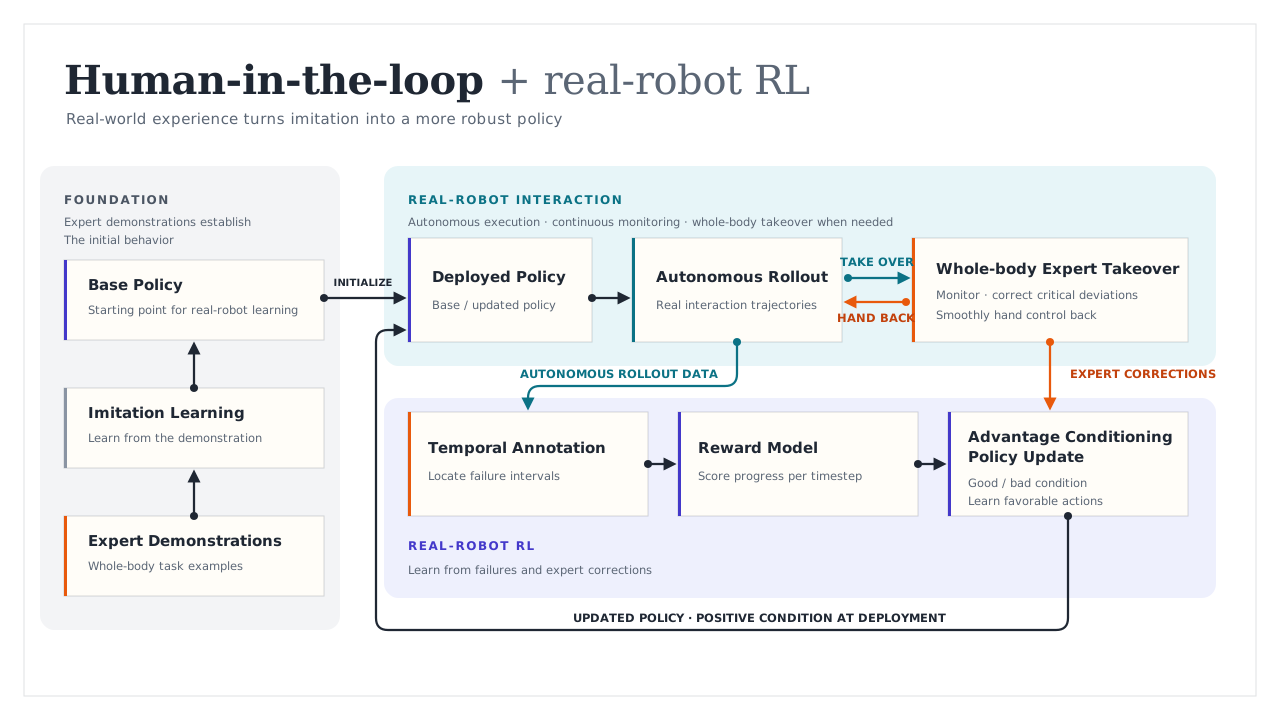
To improve real-world robustness and task success, we augment the imitation-trained base policy with human-in-the-loop intervention and real-robot reinforcement learning. Autonomous rollouts collect interaction data on the robot. A reward model learns task feedback from human-annotated failure clips and provides the signal for policy updates, while an expert assumes whole-body control when a rollout requires correction (Fig. 3).
Fig. 3. Human-in-the-loop real-robot reinforcement learning. The robot performs autonomous rollouts, with an expert taking over whole-body control when necessary. Human-annotated failure clips train the reward model, and the combined real-world data sources are used to update the policy.
Whole-body expert takeover
An expert monitors the policy during autonomous rollouts. If the robot misses a grasp, drifts off course, or settles into an ineffective motion pattern, the expert can smoothly take over whole-body control at any point, correct the motion, and return control to the policy.
For a humanoid, the transition must preserve both motion continuity and whole-body coordination. The policy and the expert therefore command the robot through the same whole-body motion pathway. At takeover and handback, the system blends their whole-body targets so that control changes without introducing a jolt into the ongoing motion.
Examples of whole-body expert takeover during execution. The expert intercepts and repositions a hand approaching the wrong grasp point while moving a box, guides a regrasp after a failed basket grasp, and stops and corrects an ineffective empty grasp toward the plush.
Real-robot RL
Expert takeover corrects the current error, while real-robot reinforcement learning turns that experience into a lasting policy update. The update uses several sources of physical-robot data. Teleoperated expert demonstrations establish the base behavior, mistakes and failures identified during autonomous rollouts train the reward model, and human-in-the-loop interventions provide corrections for those specific states. Together, these data allow us to update the base policy so that it repeats the same errors less often and more reliably recovers from a poor state to complete the task.
For policy updates, the reward model estimates task progress at each moment. The system uses this score to compute an action advantage, converts the advantage into a positive or negative condition, and guides the policy toward actions that advance the task. At deployment, the policy operates under the positive condition.
Reward-model predictions of moment-to-moment task progress for three physical-robot tasks. The on-screen curve and progress value show the model's estimate of task status.
Results
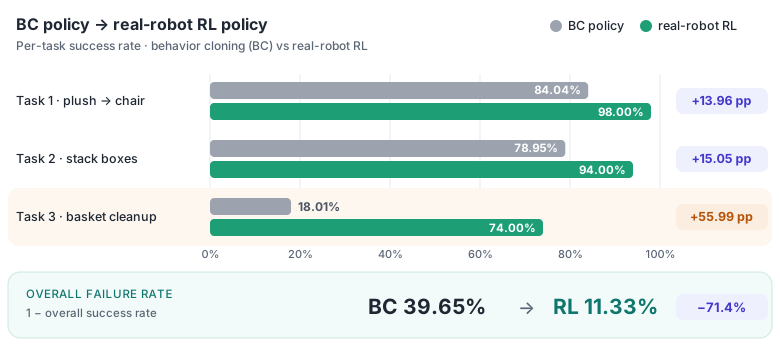
After the real-robot reinforcement-learning update, the policy outperforms the behavior-cloning (BC) baseline on all three tasks. The tasks are placing a plush on a chair, stacking boxes, and clearing items into a basket (basket cleanup). For basket cleanup, the most difficult task, success increases from 18.01% to 74.00%. Across all three tasks, the failure rate decreases from 39.65% to 11.33% (Fig. 4).
Fig. 4. Success rate for each of the three tasks, comparing the behavior-cloning (BC) baseline with the real-robot reinforcement-learning policy.
6. What it can do
The room-tidying demonstration uses one humanoid in an occupied home and is recorded as a single continuous take. Oli enters from the corner and completes each chore in sequence during a run of nearly three minutes, without cuts or resets. It walks to each location, bends toward the floor, manipulates with one or both hands, and continues to the next task. The robot stays mobile throughout the run, moving from one workspace to the next, and each chore eventually brings it close to the ground.
The unbroken run is the most demanding evaluation in this report because it is long-horizon, not because any individual chore is unusually difficult. Reliability compounds across the sequence, making completion of the full run less forgiving than completion of any single task. An uncorrected missed grasp, a loss of balance, or drift into a state absent from the demonstrations ends the entire run. Completing the sequence without a reset therefore serves as an integration test for the full stack.
The run covers the following behaviors in one home without changing policies between tasks:
Floor pickups and deep bends. Most tasks end with a bend to the floor: taking the shark plushie from a pile of boxes and setting it on the chair, lifting a box from the ground for stacking, and picking up and replacing a toy bin. Each deep bend produces a large center-of-mass shift that the whole body must absorb, providing the run's strongest test of balance.
Deformable cloth. During the laundry task, Oli removes a dirty coat from a drying rack and drops it, together with another garment, into a hamper. These soft, flexible objects do not retain a fixed shape.
Rigid box-stacking. Oli turns, picks up a box from the floor, and places it squarely on another box, a rigid-object task that requires precise placement.
Many small objects. Oli picks up a toy bin, moves the toys scattered across the desk into it one at a time, and returns the bin to the floor. The task requires a sequence of small grasps rather than a single pick.
Furniture. Oli identifies a chair left askew beside the table, straightens it, and pushes it in, manipulating an object substantially larger than its hand.
Clearing trash. At the round table where the owner is reading, Oli bends down and drops a used water bottle and other trash into the bin.
A handover to a person. Oli takes a wallet from a bookshelf and hands it directly to the owner, ending the run with a human handover rather than an object placement.
Completing a run of this length requires the full system. V³ controls locomotion and manipulation through one whole-body policy, while LimX-WBT tracks the generated targets and maintains balance for every task. The real-robot loop described in §5 records the failure and recovery states encountered during autonomous runs. The system does not switch policies between navigation and manipulation, and the scene is not reset between subtasks.
One system, the whole space
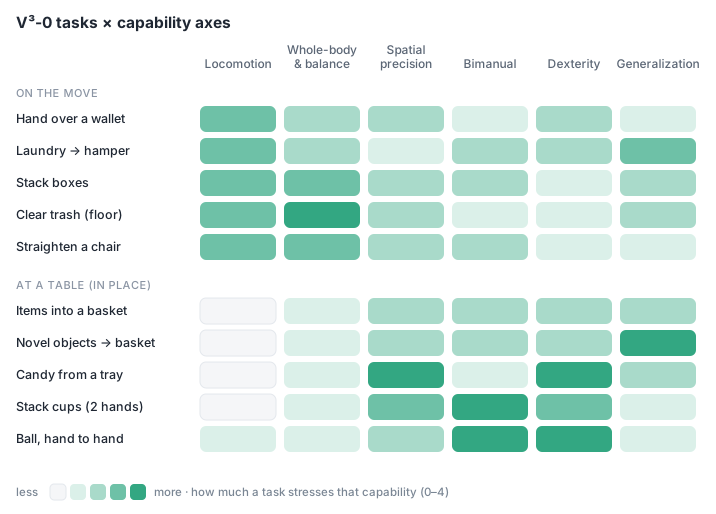
Figure 5 scores each task along six dimensions relevant to humanoid operation: travel distance, dependence on whole-body balance, grasp precision, bimanual operation, fine and in-hand dexterity, and generalization. The tasks form two profiles. Mobile tasks emphasize locomotion and whole-body balance, capabilities not addressed by a table-bound VLA; in-place tasks emphasize precision and dexterity. Together, the evaluated tasks span all six dimensions.
Figure 5. Task scores from 0–4 across six capability axes. Darker teal indicates greater demand on a capability. "Dexterity" includes fine finger-level and hand-to-hand manipulation.
The same tasks, rearranged
To distinguish task execution from replay of a memorized routine, each run begins with a person manually rearranging the scene. The person swaps objects, changes their colors, and drops them in unconstrained locations, then leaves before the robot starts. Each clip therefore begins from an arrangement that was not predefined for the robot.
Side-by-side executions of the same laundry pickup with the black coat used in the main run and with a white coat. The garment color changes, while the behavior remains the same.
Two tasks performed in scenes arranged immediately before execution: discarding the shark and moving a pink box placed at an unconstrained location.
A retry after a missed grasp. In this clip, Oli misses the target on the first reach. It steps back, bends again, and succeeds on the second attempt. This recovery was recorded on the physical robot. Autonomous rollouts log states of this kind, with an expert intervening when necessary.
The same pipeline, standing still
The preceding tasks emphasize mobile manipulation, but the same pipeline also supports stationary, dexterous work at a table. The slow system, fast system, and LimX-WBT remain unchanged, and the training procedure for each component is the same as before; only the task differs.
Left: Base scenario. The robot stands at a table, picks up each object on the tabletop in sequence, and places it in a basket. Right: The same task with a randomized initial scene and progressively introduced objects, including objects with limited representation in the training data and objects the model has never seen. The robot continues to complete the picking and collection task successfully.
Left: Fine manipulation. The robot picks up tiny candies from a tray, where a millimeter-scale positioning error can cause a missed grasp. Right: After a failed grasp, the robot promptly adjusts its motion and retries until it picks up the candy.
Left: Bimanual coordination. The robot picks up one cup in each hand and stacks both on a third cup. Right: Dexterous hand-to-hand transfer. The robot picks up a ball with one hand, passes it laterally to the other, and places it in a basket.
All of these examples use the same VLA and whole-body controller.
Nothing is staged
The same table-clearing task in two layouts. The toys and their positions change on every run; the robot grasps whatever is on the table and drops it into the bag.
Three factors vary across runs without preventing task completion: the objects (for example, a white coat instead of a black one, or different toys and plushies), their colors, and their positions. Objects are dropped by hand rather than placed on marked locations. The policy is therefore executing the task across varied setups rather than reproducing one memorized arrangement.
7. Conclusion and outlook
At the beginning of the year, we released COSA 0, the first version of our robot OS. COSA 0.5 updates S1, the VLA layer, and S0, the motion-control layer; this report describes those updates. V³-0 is a complete VLA stack operating on a physical humanoid. Its slow system interprets the scene and instruction, its fast system generates whole-body motion, and S0 provides whole-body tracking and balance. A real-robot training loop combines whole-body expert takeover, a reward model, and reinforcement-learning updates to improve the policy on the robot. Across the three evaluated tasks, the updated policy outperforms the behavior-cloning baseline.
Next, we are expanding the task set, data, and evaluation in the following areas:
Scaling real-robot RL: adding tasks, scenes, and autonomous-rollout data, and evaluating the updated policy across the expanded set.
Closing S0's loop with real data: using physical-robot data to reduce the remaining sim-to-real gap for long-horizon, large-amplitude motion, where simulation is least reliable.
Contact and force: adding explicit force and impedance terms to the S1→S0 interface for contact-rich tasks in which applied force matters as much as target position.
Task and object diversity as a foundation: the tidying run already spans deformable cloth, rigid box-stacking, furniture, many small objects, and a handover to a person, all in one home. That breadth provides the foundation for further generalization.
Generalization and cross-platform evaluation: evaluating unseen objects and scenes, as well as additional LimX platforms beyond the robot used in this report.
We will continue to measure progress on the physical robot.
References
[1] Luo, Zhengyi, et al. "SONIC: Supersizing motion tracking for natural humanoid whole-body control." arXiv preprint arXiv:2511.07820 (2025).
[2] Black, Kevin, Allen Z. Ren, Michael Equi, and Sergey Levine. "Training-Time Action Conditioning for Efficient Real-Time Chunking." arXiv preprint arXiv:2512.05964 (2025).
Citation
If you’d like to cite this post, you can use the following BibTeX entry:
@online{fu2026cosa05,
author = {Zhen Fu and Tao Yu and Hongbo Zhu and Haoxiang Luo and Zhiming Chen and Pinxi Shen and Jiaqi Song and Zheyi Zhao and Bozhen He and Jiangtao Hu and Cong Shen and Haolin Ma and Zimo Huang and Ben Liu and Wei Zhang and Hua Chen},
title = {Introducing {COSA} 0.5: A Whole-Body Capability Upgrade for the Humanoid {VLA} {V³-0}},
date = {2026-07-15},
year = {2026},
url = {https://limxdynamics.com/cosa05v3/#en},
}